The setup in 30 seconds
- A “gap and go” is a stock that gaps up before the open on real news and keeps climbing after the 9:30 AM open, breaking through its pre-market high.
- Most gaps fade. The ones that run share a short profile: a stock-specific catalyst, pre-market volume well above normal, and a float small enough for demand to move the price.
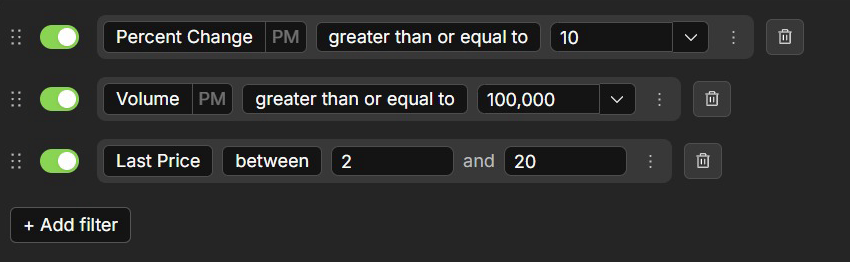
- Find them in Scanz with three filters: Percent Change | PM ≥ 10, Volume | PM ≥ 100,000 and Last Price between $2 and $20. Any one of three scanners can run them: the Data Scanner for a live list, the News Scanner for gappers with a headline, the Signal Scanner for the moment one breaks its high.
- Enter at or just after the open, when the stock breaks its pre-market high on volume. If it opens and starts filling back toward pre-market prices, it is fading: skip it.
What the “Gap and Go” Strategy Actually Is
A gap up happens when a stock opens higher than it closed the previous session. The “gap and go” is the trade: you buy the breakout at or just after the open, expecting the move to continue.
The logic is simple. Stocks that gap on news and high volume have institutional attention. If sellers can’t push the price back below the prior close in the first few minutes, the path of least resistance is up.
The hard part isn’t understanding the setup. It’s identifying which gappers are worth trading before the market opens — and ignoring the rest.
Why Most Gap Setups Fail Before 9:31 AM
On any given morning you might see 30–80 stocks gapping 5% or more pre-market. Most will fade within the first 15 minutes.
Faders share a pattern: weak volume relative to float, no clean catalyst, gaps driven by overnight sector noise rather than stock-specific news. They open, trigger some buy orders, and get hit by sellers who were waiting.
Runners look different. Volume is already well above average before 9:30. There’s a catalyst you can point to — earnings surprise, FDA approval, partnership announcement. Float is small enough that demand pressure actually moves the price.
The filter work happens pre-market. If you’re making these decisions at 9:31, you’re already late.
Three Ways to Find “Gap and Go” Setups in Scanz
Scanz has three scanners, and each one can find “gap and go” candidates on its own. None of them needs the others: pick the one that fits how you trade, or run more than one side by side. All three use the same filter engine, so the same gapper filters work in each. What changes is what you see.
1. The Data Scanner: a live list of today’s gappers
The Data Scanner gives you a ranked, constantly updating list of every stock that matches your filters. Use it if you want to see the whole field before the open and choose from it.
A pre-market gapper scan typically runs three core filters:
Percent Change | PM ≥ 10 — isolates stocks gapping at least 10% pre-market. Tighten or loosen this depending on market conditions.
Volume | PM ≥ 100,000 — volume confirmation is non-negotiable. A 15% gap on 8,000 pre-market shares means nothing. A 15% gap on 300,000 shares is a different conversation.
Last Price — filter to your price range. Most “gap and go” traders work in the $2–$20 range where moves are fast and float is naturally limited.
The three filters going in on a live pre-market session. Each one narrows the list, from nearly 200 stocks up 10% to a few dozen tradable gappers.
You can layer in a float filter to restrict to low-float names specifically. The filter reference has the exact Shares Float filter details.
Run this scan from around 7:00 AM ET. By 8:30 you should have a short list — five to fifteen names depending on market conditions.
Pre-Market Gappers and Gap & Go also ship as ready-made scans in Scanz. See one real morning, from the pre-market list to the open, on the pre-market gap scanner page.
2. The News Scanner: gappers with a catalyst
A stock gapping 12% pre-market with 200K volume is interesting. A stock gapping 12% on a positive earnings surprise with 200K volume is a trade candidate.
The News Scanner shows headlines instead of a list of stocks. Give it the gapper filters — Percent Change | PM ≥ 10 and Volume | PM ≥ 100,000 — and the feed shows news only for stocks that are gapping right now, with the % change and volume beside each one. Use it if the catalyst is what you trade on.
The gapper filters applied to headlines. Filings and press releases for today’s gappers, newest first.
The question it answers: is this gap stock-specific or sector noise? Stock-specific gaps on real catalysts hold. Sympathy plays and macro moves fade faster.
3. The Signal Scanner: the moment a gapper breaks out
The Signal Scanner doesn’t show what matches right now. It fires an event the moment something happens — a stock printing a new high, crossing its moving average, or posting a volume spike. Use it if entry timing is what matters most to you: a list can tell you a stock is above its pre-market high, but not whether it crossed one minute ago or thirty.
For the “gap and go,” add a New High signal with the session set to Full Day, then give it the gapper filters. Before the bell, the day’s high is the pre-market high, so the first Full Day new high after 9:30 is the break of the pre-market high — and the filters keep it to gappers. The moment it fires, you have real-time breakout confirmation — not a reading you’re checking after the fact.
The New High signal with the gapper filters, recorded across the open. Each row is a gapper breaking its high the moment it happens.
What Good Execution Actually Looks Like
Whichever scanner surfaced the stock, the execution decision at the open is binary: did it break pre-market high with volume?
If yes — it’s running.
If it gaps open and immediately starts filling back toward pre-market prices — it’s fading. Skip it.
Most traders who struggle with this setup are either entering too early (pre-market, before the open confirms direction) or watching too many names at once. The scan does the filtering. By the time the bell rings, you should be watching two or three stocks, not twenty.
Frequently Asked Questions
What is the “gap and go” strategy in trading? The “gap and go” strategy involves buying a stock that has gapped up pre-market and continues higher once the market opens. The trade works when the gap is driven by a real, stock-specific catalyst — earnings, news, or an approval — and confirmed by above-average pre-market volume.
What causes a stock to gap up? Stocks gap up when significant news breaks between sessions — earnings beats, FDA approvals, analyst upgrades, or major contract announcements. Gaps can also be driven by sector momentum or broader market moves, though those tend to be weaker “gap and go” setups.
How do I find “gap and go” stocks before the market opens? Use a pre-market scanner filtering for Percent Change | PM ≥ 10% and Volume | PM ≥ 100,000. This narrows the field to stocks with both price movement and volume confirmation. In Scanz, this is a standard Data Scanner setup you can run from 7:00 AM ET.
How do I know if a gap will hold or fade? The strongest indicators: a stock-specific catalyst, pre-market volume well above the stock’s average, and a float small enough that demand pressure moves the price. Gaps on thin or sector-wide catalysts fade more often.
What’s the difference between a gap up and a “gap and go”? Every “gap and go” starts with a gap up, but not every gap up becomes a “gap and go.” The gap is the pre-market move. The “go” is the continuation through the open. The gap tells you something happened; the go tells you buyers are still in control after the bell.
Should I enter a “gap and go” pre-market or at the open? Most traders enter at or just after the open, once the stock confirms it’s breaking above the pre-market high with volume. Pre-market entries carry more spread risk and less confirmation. The Signal Scanner in Scanz can fire the instant a stock breaks its pre-market high at the open.
Can the “gap and go” strategy work for short trades? Yes — the inverse is the gap and fail: a stock gaps up, fails to hold, and reverses. The same scan logic applies, but you’re watching for the breakdown rather than the breakout.
Start a free Scanz trial and set up your pre-market gapper scan before tomorrow’s open — the Data Scanner, Signal Scanner, and News Scanner are all included in the Scanz real-time stock scanner. See plans and pricing. No commitment required.